
We Scraped 250+ Founder Case Studies. Here Are the 10 GTM Strategies That Actually Work.
Every startup founder asks the same question: “What is the fastest way to get my first 100 paying customers?” The internet is full of growth hacks, Twitter threads, and conflicting advice. We decided to look at the hard data.
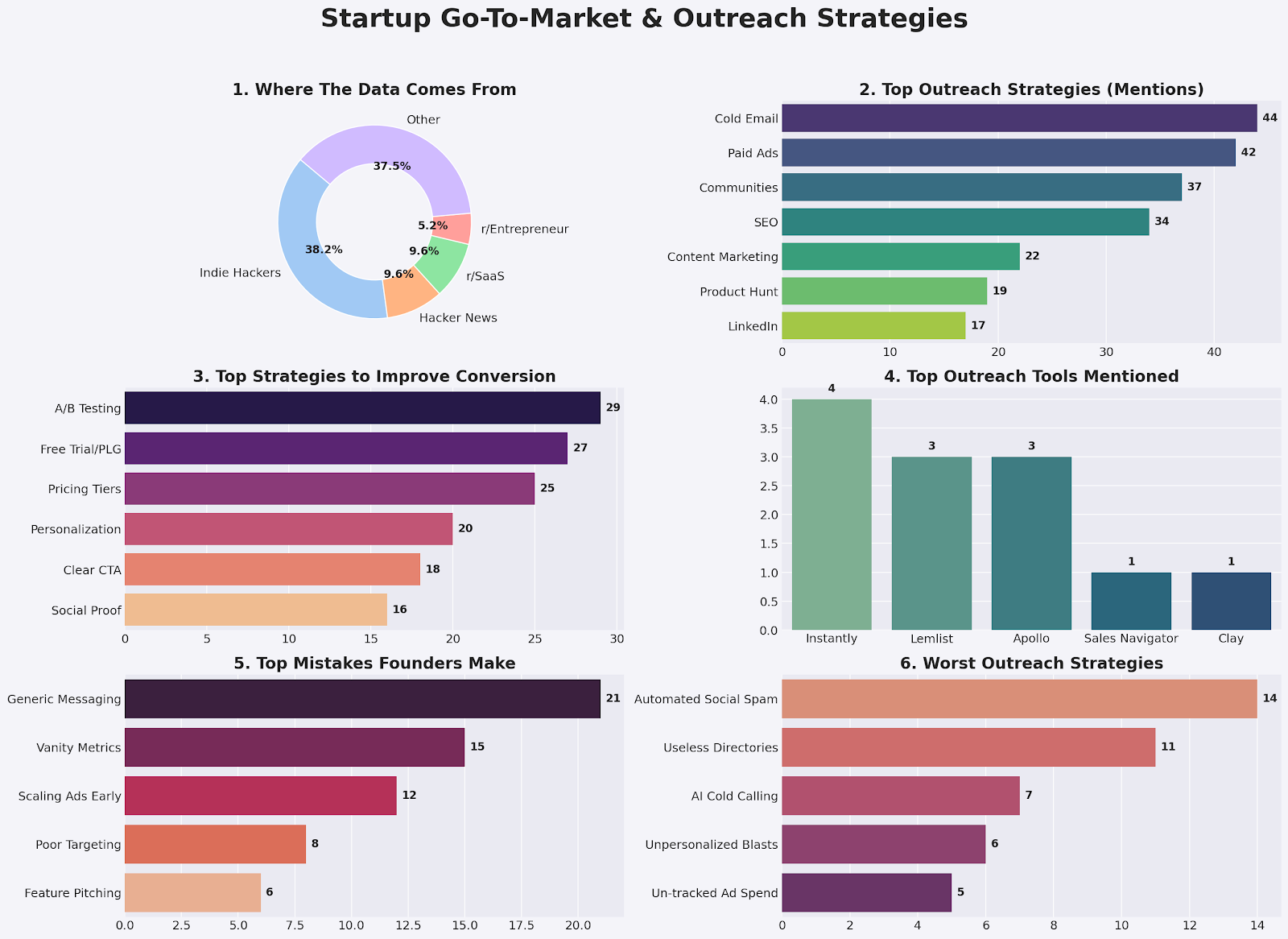
We analyzed 251 real-world case studies sourced from Indie Hackers, Hacker News, and r/SaaS. The goal: find which go-to-market strategies move the needle and which ones just burn cash.
Here are the top 10 data-backed insights on what founders think will work versus what drives SaaS customer acquisition.
Vanity Metrics Are a Trap
Many early-stage founders celebrate massive top-of-funnel numbers like thousands of free signups. The data shows these metrics can be a lethal distraction.
One founder attracted 1,000 free signups but only converted 23 into paying customers. That's a 2.3% conversion rate. They restructured their product-led growth motion by adding intentional friction. They required a work email and a brief onboarding survey. Total users dropped to 400, but paying customers jumped to 41, a 10.25% conversion rate.
Filter out tire-kickers. Intentional friction reduces your support load and improves your unit economics.
High-Intent Cold Email Beats Mass Blasts
Cold email remains the top B2B SaaS outreach channel. But execution dictates your ROI. Buying a generic list of 10,000 emails and blasting templates no longer works.
One operator sent 100,000+ generic emails a month and scraped a 1.6% reply rate. Another founder sent just 500 highly-targeted emails and achieved an 11% response rate, yielding 11 paying customers in one week. The difference: they scraped public complaints on Reddit and Twitter where prospects mentioned the exact problem the SaaS solved. The emails had zero feature pitching, just a 4-sentence request for a 15-minute feedback call.
Target prospects who have already articulated the pain point your software solves. Relevancy scales better than volume.
Paid Ads Burn Bootstrapped Budgets
Founders assume Google or Facebook ads are the fastest growth engine. The case studies reveal that paid acquisition is a trap for early-stage, bootstrapped startups.
Multiple founders burned through early marketing budgets on Meta and Google Ads with zero conversions. Paid traffic is too expensive in competitive software categories without VC backing. The most successful pivots involved abandoning paid ads in favor of long-tail SEO.
Write hyper-niche, technical “how-to” articles. One founder grew a weekend project to $20k/month by targeting low-volume (100 searches/month) but high-intent keywords.
Community-Led Growth Requires Giving First
Reddit, Hacker News, and Slack communities are great channels for early adopters. They are also hostile to traditional marketing.
Founders who used automated DMs or dropped raw product links were routinely banned. The winning strategy was manual and authentic. One founder spent two weeks tracking keywords like “struggling with” or “alternative to [Competitor]” across niche subreddits. By being the first to provide a genuinely helpful, non-promotional answer, they achieved a 40% DM-to-signup conversion rate.
Become a native contributor. Share your failures. Post detailed breakdowns without mentioning your product. Only pitch your tool when it directly answers a user's specific problem.
Test Your SaaS Pricing
Founders often set pricing tiers based on gut feeling. Small psychological tweaks have a measurable impact on monthly recurring revenue.
A SaaS founder ran a direct A/B test on “charm pricing” ($49 / $149 / $299) versus round numbers ($50 / $150 / $300). Prices ending in “9” outperformed round numbers in conversion rates across every tier.
Test your assumptions on real traffic. A $1 difference in a pricing tier can be the difference between a bounce and a conversion.
Fix Involuntary Churn Before Spending on Acquisition
Founders focus on top-of-funnel acquisition but bleed recurring revenue out the back door through failed payments.
On average, startups lose 0.8% of their user base every month solely to credit card failures. Founders who implemented automated dunning workflows and smart payment retry logic recovered 70% of that lost revenue. Companies maintaining a Net Retention Rate above 106% grew 2.5x faster than those below.
Fix your leaky bucket first. Recovering failed payments requires zero marketing spend and is the easiest ROI your startup will get.
Launch Where the Audience Lives
A classic piece of outdated startup advice is to submit your SaaS to 100+ “startup directories” for SEO backlinks and early traffic. The data proves this wastes time.
One case study tracked this: days spent submitting to directories generated just 3 free signups and zero paying customers. The winning strategy was focusing on platforms with active, engaged audiences, specifically Product Hunt and Peerlist. Founders who focused their energy there achieved a 19% conversion rate.
Stop submitting links to dead directories. Focus your launch energy where actual early-adopters already hang out.
Your First Email Carries the Most Weight
Founders are told to build elaborate 7-step cold email follow-up sequences. The data shows that if your first email is weak, follow-ups won't save you.
An operator sending over 100,000 cold emails per month found that 58% of all replies come from the first email. The highest-performing first emails shared three traits: under 80 words, a single call to action, and follow-ups framed as casual replies rather than formal reminders. That framing boosted follow-up performance by about 30%.
Spend 90% of your time perfecting Email #1. Keep it short. Make a single ask.
Beware the Audience Network Trap in Paid Ads
If you run paid advertising, leaving default platform settings on will burn your budget.
A deep-dive into B2B paid ads revealed staggering bot and click-fraud rates on third-party Audience Networks. Provable bot traffic rates: TikTok 79%, Meta Audience Network 67%, Google Display Network 27%. These bots click ads and submit fake leads, inflating your KPIs while starving your sales team of real prospects.
Disable Audience Network and Display Network expansion in your ad campaigns. A $2 lead is worthless if it's a bot. Force your ads to show natively in the platform's primary feed.
Use LinkedIn DMs for Trust-Based Asks
Cold email is the top channel for high-volume sales outreach. But it underperforms when you need to ask for a favor, collect feedback, or gather social proof.
An indie hacker ran an experiment to collect user testimonials. Personalized cold emails hit a 19% response rate. They pivoted to LinkedIn DMs targeting the same profile of users. LinkedIn outreach generated a 50% response rate, making it 2.5x more effective than cold email for this task.
The medium matters. When asking for a favor or testimonial, prospects need to know you are a real human. LinkedIn's built-in credibility, photo, and work history lower the prospect's guard in a way a cold email never can.
Precision Beats Volume
The theme across these 250+ case studies is clear. Precision beats volume. Whether you are optimizing SEO, crafting cold emails, or engaging in Reddit communities, targeted actions outperform generic marketing blasts.
This growing database of 250+ SaaS and startup case studies is available for querying in the Wovly app. We use it to guide users to curated, proven strategies. Log in to find the exact insights and GTM tactics for your specific niche.
Keep reading



Ready to make better strategic decisions?
See how Wovly helps teams turn tough business problems into structured experiments.
Get Started